

We get your business up and moving. We are a passionate bunch of number crunchers /budget heads. Whether it be an entire overhaul of your accounting department, managing your payrolling, or simply serving you as a bookkeeper – we are here.

Gujarat has once again reinforced its position as India’s most investment-friendly state with the launch of the Viksit Gujarat Industrial Policy 2026, a comprehensive industrial growth framework designed to attract ₹10 lakh crore in investments over the next five years. The policy aims to accelerate industrial expansion, create large-scale employment opportunities, strengthen Gujarat’s position in global supply chains, and establish the state as a preferred destination for advanced manufacturing, semiconductors, clean energy, electronics, and technology-driven industries.
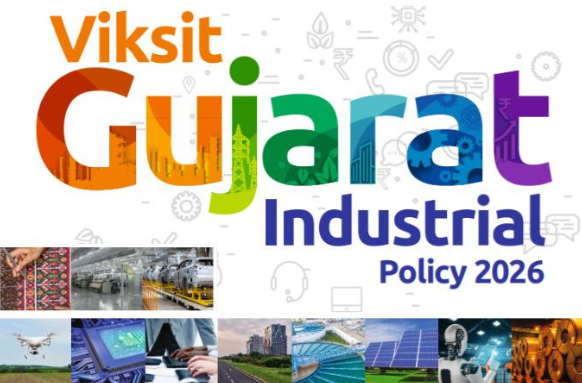
For investors, entrepreneurs, multinational corporations, and MSMEs, the policy signals a significant shift toward outcome-based incentives, flexibility in government support, and a stronger emphasis on future-ready industries. At a time when India is competing aggressively for global manufacturing investments, Gujarat’s latest policy demonstrates how states are becoming key drivers of economic transformation.
This article examines the key provisions, investment opportunities, business implications, and strategic outlook of Gujarat Industrial Policy 2026 from a financial and regulatory perspective.
Over the past two decades, Gujarat has consistently ranked among India’s top industrial states due to its robust infrastructure, business-friendly governance, strategic coastline, industrial corridors, logistics connectivity, and proactive policymaking. The state has developed strong industrial ecosystems across petrochemicals, chemicals, pharmaceuticals, engineering, textiles, automobiles, renewable energy, and ports.
The previous industrial policy framework, combined with initiatives such as the Aatmanirbhar Gujarat Schemes and sector-specific incentives, helped attract significant investments and foster industrial development across districts.
The new Industrial Policy 2026 seeks to build upon this foundation while aligning with emerging global trends such as:
One of the headline announcements under the new policy is the government’s target to attract ₹10 lakh crore in fresh investments over the next five years. The policy aims to achieve this by offering flexible incentive structures and encouraging investments across both traditional and sunrise sectors.
This investment target is significant for several reasons:
India is positioning itself as a global manufacturing alternative amid geopolitical shifts and supply chain realignment. Gujarat seeks to capture a substantial share of this opportunity by strengthening industrial clusters and attracting large-scale manufacturing projects.
The policy places strong emphasis on job creation alongside capital investment. Government reports indicate that employment generation is being incorporated as an important parameter for qualifying for higher levels of incentives.
The focus is not merely on attracting capital but on building globally competitive industrial ecosystems around high-value sectors including semiconductors, electronics, advanced engineering, and clean technologies.
A notable shift under the new policy is the introduction of a more flexible incentive framework. Instead of a one-size-fits-all model, businesses may be allowed to choose combinations of incentives that best suit their project requirements. This approach is expected to improve capital allocation efficiency and attract a wider variety of investors.
Potential incentive options include:
Such flexibility is particularly beneficial for industries with varying capital structures and operational requirements.
Micro, Small and Medium Enterprises remain a crucial pillar of Gujarat’s economy. The policy is expected to continue support for MSMEs through financial assistance, technology adoption schemes, infrastructure support, and easier access to government incentives.
For MSMEs, the policy offers opportunities to:
Given that MSMEs contribute significantly to employment generation, their development remains central to Gujarat’s industrial strategy.
Semiconductors are becoming a strategic priority globally. Gujarat has already attracted significant attention in the semiconductor ecosystem due to its infrastructure readiness and policy support.
The Industrial Policy 2026 explicitly identifies semiconductors as a priority sector and seeks to position Gujarat as a major manufacturing and innovation hub for semiconductor fabrication, assembly, testing, and related supply chains.
This could unlock substantial opportunities for:
The policy recognizes the growing importance of environmental sustainability and green industrial development. Gujarat’s leadership in renewable energy positions it well to attract investments in:
The transition toward sustainable industrialization is expected to attract both domestic and foreign investors seeking ESG-aligned investment opportunities.
The government aims to support next-generation manufacturing sectors by encouraging technology adoption and industrial modernization.
Priority areas include:
This aligns Gujarat with global manufacturing trends and strengthens its competitiveness in international markets.
One of the most discussed features of the new policy is the proposed introduction of an “Ultra Mega” industry category.
Reports indicate that projects investing at least ₹10,000 crore and generating substantial employment may qualify under this category. Additional investment thresholds may require corresponding increases in employment commitments.
The significance of this initiative lies in its ability to attract:
Such projects often generate multiplier effects across the economy through vendor development, ancillary industries, logistics demand, and workforce expansion.
One of Gujarat’s strongest competitive advantages has been its administrative efficiency.
The Industrial Policy 2026 continues to prioritize:
Government communications indicate that ease of doing business will remain central to the state’s industrial development agenda.
For investors evaluating multiple locations across India, administrative efficiency often becomes as important as financial incentives. Gujarat appears determined to maintain its leadership position in this area.
Foreign direct investment (FDI) flows into India are increasingly targeting manufacturing, electronics, clean energy, and technology sectors.
The Gujarat Industrial Policy 2026 is likely to strengthen investor confidence by providing:
International companies looking to establish manufacturing bases in India may find Gujarat particularly attractive due to its established industrial ecosystem and investor-centric governance framework.
While large corporations may dominate headlines, the policy also creates opportunities for startups and emerging businesses.
Entrepreneurs entering Gujarat’s industrial ecosystem can benefit from:
As investment inflows increase, demand is expected to rise for compliance, accounting, tax advisory, legal structuring, and business formation services. New businesses entering Gujarat’s industrial landscape will require professional support to navigate regulatory approvals, registrations, incentive applications, and corporate governance requirements.
This creates a strong ecosystem not only for manufacturers but also for professional service providers supporting industrial growth.
From a finance and investment standpoint, the success of Gujarat Industrial Policy 2026 will ultimately depend on execution.
Key performance indicators to monitor over the coming years include:
Announcements alone do not create economic value. Investors should monitor how much of the proposed ₹10 lakh crore investment pipeline converts into actual project implementation.
The policy’s focus on employment-linked incentives suggests that job creation will be a major success metric.
The extent to which Gujarat attracts investments beyond traditional industries into semiconductors, advanced manufacturing, and clean energy will shape its long-term competitiveness.
A healthy industrial ecosystem requires strong MSME integration. Monitoring MSME participation and access to incentives will provide insight into the policy’s inclusiveness.
The Viksit Gujarat Industrial Policy 2026 represents one of India’s most ambitious state-level industrial development initiatives in recent years. With a target of attracting ₹10 lakh crore in investments, a strong focus on advanced manufacturing, semiconductors, clean energy, MSME growth, employment generation, and ease of doing business, Gujarat is positioning itself at the forefront of India’s next industrial growth cycle.
For investors, multinational corporations, entrepreneurs, and growing businesses, the policy offers a compelling combination of financial incentives, regulatory support, infrastructure readiness, and long-term growth potential. If implemented effectively, Gujarat could further strengthen its reputation as India’s premier destination for industrial investment while contributing significantly to the country’s manufacturing and economic ambitions.
As businesses evaluate opportunities arising from Gujarat Industrial Policy 2026, professional guidance becomes critical for structuring investments, regulatory compliance, incentive eligibility assessments, tax planning, and business formation services. GJM & Co. assists domestic and international businesses with company incorporation, FEMA advisory, virtual CFO services, tax compliance, transaction structuring, startup advisory, and end-to-end business setup support. To discuss your investment or expansion plans in Gujarat, connect with our team at info@gjmco.com.